


Do you dream of your own thermopool that combines low energy consumption and long service life? Then you have come to the right place.
This guide is your complete roadmap to everything you need to know for 2026. You get clear answers on how to choose, build, and maintain your thermopool for the best possible results.
We spark your interest with unique possibilities, create a desire for a simple and sustainable pool life, and encourage you to read on to make the right decision.
Here you will find everything about what a thermopool is, its pros and cons, the construction process, costs, energy aspects, maintenance, add-ons, and frequently asked questions.
What is a Thermopool?
Understanding what a thermopool is gives you the foundation for choosing the right solution for your garden. This pool type has become a natural choice for many Swedish pool owners thanks to its unique construction and energy-smart features.
Definition and core principles
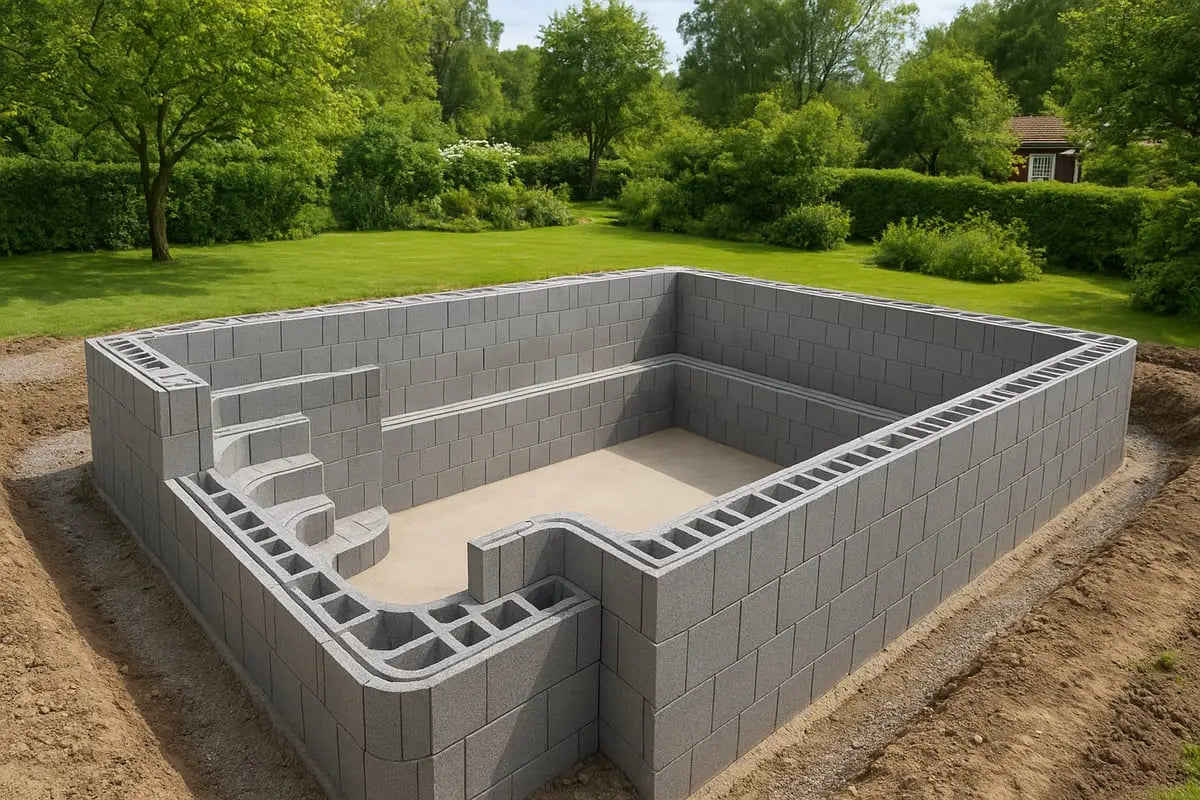
A thermopool is a pool type built with insulating polystyrene blocks, which provide excellent thermal insulation and stability. The blocks are stacked and filled with rebar and concrete, creating a robust and energy-efficient structure. This sets thermopools apart from steel pools, fiberglass pools, and traditional concrete pools, where insulation is often inferior or completely absent.
The block system works much like large Lego pieces, making it possible to customize both size and shape as desired. Common dimensions include, for example, 4x8 meters, but round and custom-shaped solutions are also possible. The history of thermopools in Sweden dates back to the 1990s and has developed rapidly. Today, Thermopool NXT is Sweden’s best-selling pool construction, according to Poolgiganten. Looking ahead to 2026, there is a clear trend of more people choosing energy-smart pools with flexible design. For a deeper understanding, please read this in-depth guide to thermopools.
Advantages of Thermopool
Thermopools offer several decisive advantages:
- Superior insulation reduces heat loss and delivers low energy consumption.
- The construction is robust with a long service life, often longer than 30 years.
- Great flexibility in both design and size, enabling the pool to be adapted to different plots.
- Option for fully or partially in-ground installation.
- Excellent adaptation to the Nordic climate thanks to the insulation.
- Customer cases show that a thermopool can increase property value.
- Statistics show that thermopools provide significantly lower heating costs than steel pools.
These advantages make thermopools a wise choice if you seek sustainability and energy efficiency.
Disadvantages and challenges
There are also challenges with thermopools:
- The initial investment is often higher than for simpler pool types.
- Correct installation is crucial for a good end result.
- Ground preparation requires precision, especially for drainage.
- Self-building can be difficult without prior experience.
- The blocks are bulky and can be heavy to handle.
- Common DIY mistakes include, for example, incorrect reinforcement or insufficient drainage.
Despite these challenges, the investment often pays off through lower energy costs and long service life.
Comparison with other pool types
Thermopools compare well against other pool types. Here is an overview:
| Pool type | Insulation | Durability | Price | Flexibility | Build time |
|---|---|---|---|---|---|
| Thermopool | Very high | Very high | Medium/High | High | Medium |
| Steel pool | Low | Medium | Low | Medium | Fast |
| glasfiberpool | Medium | High | Medium | Low/Medium | Fast |
| Concrete pool | Low/Medium | High | High | Very high | Slow |
Thermopools are particularly suitable in Nordic climates thanks to their excellent insulation. Statistics show that thermopools account for a growing share of new pools in 2025 and dominate the premium segment in Sweden. If you prioritize energy savings and customization options, a thermopool is often the best choice.
Planning and Choosing a Thermopool
Planning for a thermopool requires both thoughtfulness and care. The right thermopool delivers long-lasting swimming enjoyment, low operating costs, and harmonious integration into your outdoor environment. Here we guide you through the key steps to find the optimal solution for 2026.
How do you choose the right thermopool?
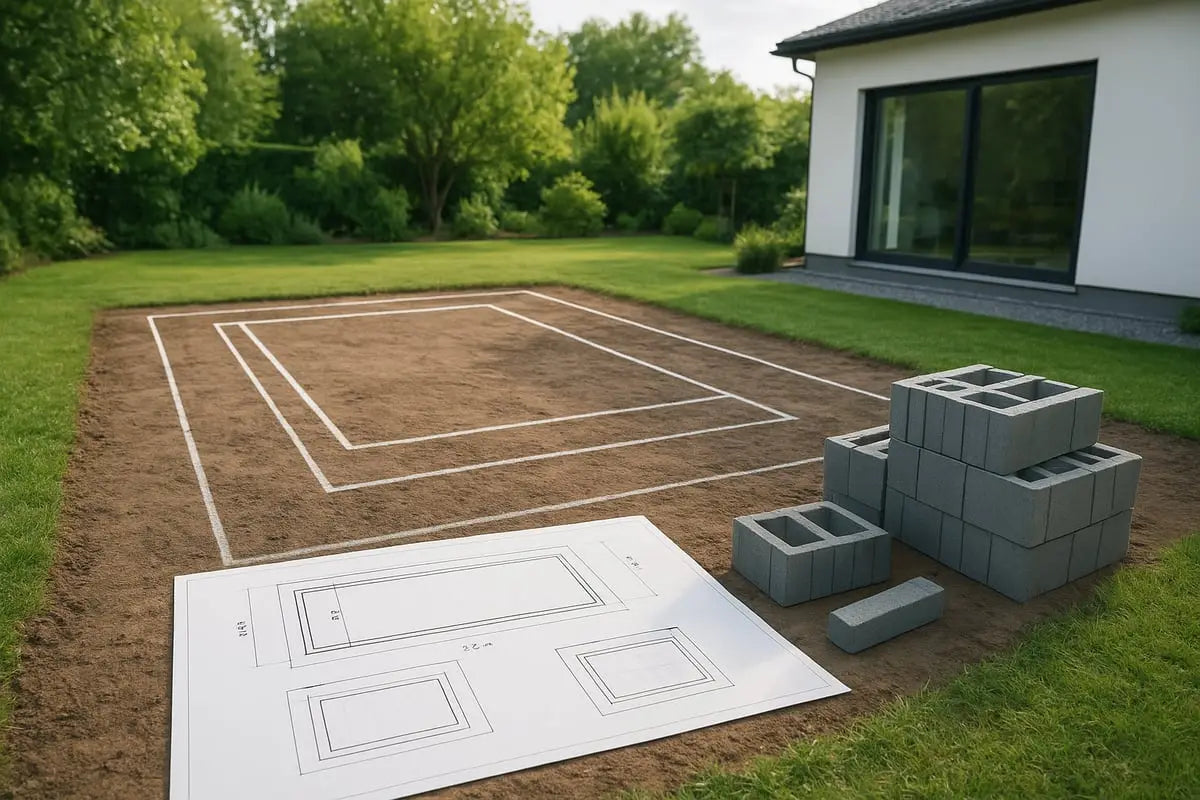
Choosing a thermopool starts with analyzing your plot’s conditions. Check ground bearing capacity, slope, and proximity to electricity and water. How many people will use the pool? Family use, training, or play affects size and depth.
The most common sizes in Sweden are 4x8 meters, but 3x6 meters is also popular for smaller plots. Adapt the pool’s shape and placement to your garden’s style and space. A well-planned thermopool blends in and increases the value of the entire property.
| Pool size (m) | Share installed 2025 (%) |
|---|---|
| 4x8 | 40 |
| 3x6 | 25 |
| 3.5x7 | 15 |
| Other | 20 |
By choosing the right dimensions, you get the best swimming experience and economy. Think long term when planning your thermopool.
Key choices: block type, liner, steps, and accessories
Thermopools are built with different block types, for example NXT or URSTARK. These affect insulation, strength, and price. The choice of liner is critical for both aesthetics and maintenance. Color and pattern can significantly change the pool’s appearance.
Also consider whether you want steps, a ladder, or a ramp. Steps provide both safety and comfort, especially for children and seniors. Popular accessories include LED lighting, waterfalls, and a jet stream for training. The right accessories expand use cases and increase your thermopool’s value.
Combining several options from the start provides a more complete and personalized pool experience. Review the possibility of adding extra features for future needs.
Energy-smart and sustainable solutions
Insulation in a thermopool is central to minimizing energy consumption. Choose an energy-efficient heat source, such as a heat pump or solar collector. Pool covers and pool enclosures reduce heat loss and extend the swimming season.
Automatic purification systems simplify maintenance and contribute to a stable water climate. By combining a thermopool with a pool enclosure, the season can often be extended from April to October, while the energy cost can be halved.
Statistics show that with the right combination of insulation and a pool enclosure, the energy cost can be reduced by up to 50 percent. Invest in sustainable solutions for both the environment and the economy.
Permits, regulations, and insurance
Before starting construction, you need to check whether a building permit is required for your thermopool. Rules regarding distance to property boundaries and safety vary between municipalities. A pool cover is a legal requirement to prevent accidents, especially if children are nearby.
Insurance companies often impose requirements on installation and protection. Make sure to document all steps and choose CE-marked products. A common mistake is missing the building permit application or underestimating the importance of proper ground preparation.
By being thorough with regulations and insurance, you avoid unnecessary costs and delays. Proper preparation makes the process safe and smooth.
Budget and financing
The cost of a thermopool starts around 150 000 kronor excluding labor, but the total cost depends on groundworks, size, and options. Financing and installment solutions are often available via suppliers. The average investment in Sweden in 2025 is around 250 000 kronor.
To understand which factors affect the price, it is recommended to read more about cost to build a pool. Always request quotes from multiple providers to get a fair picture. Plan your budget carefully to avoid unexpected expenses.
Step by step: How to Build a Thermopool
Building a thermopool is a comprehensive project, but with the right planning and careful execution the result is both durable and energy smart. Here we go through the process step by step, from groundworks to a finished pool. If you want to delve further into the process, we recommend The thermopool construction process for a detailed guide.
Preparations and groundworks
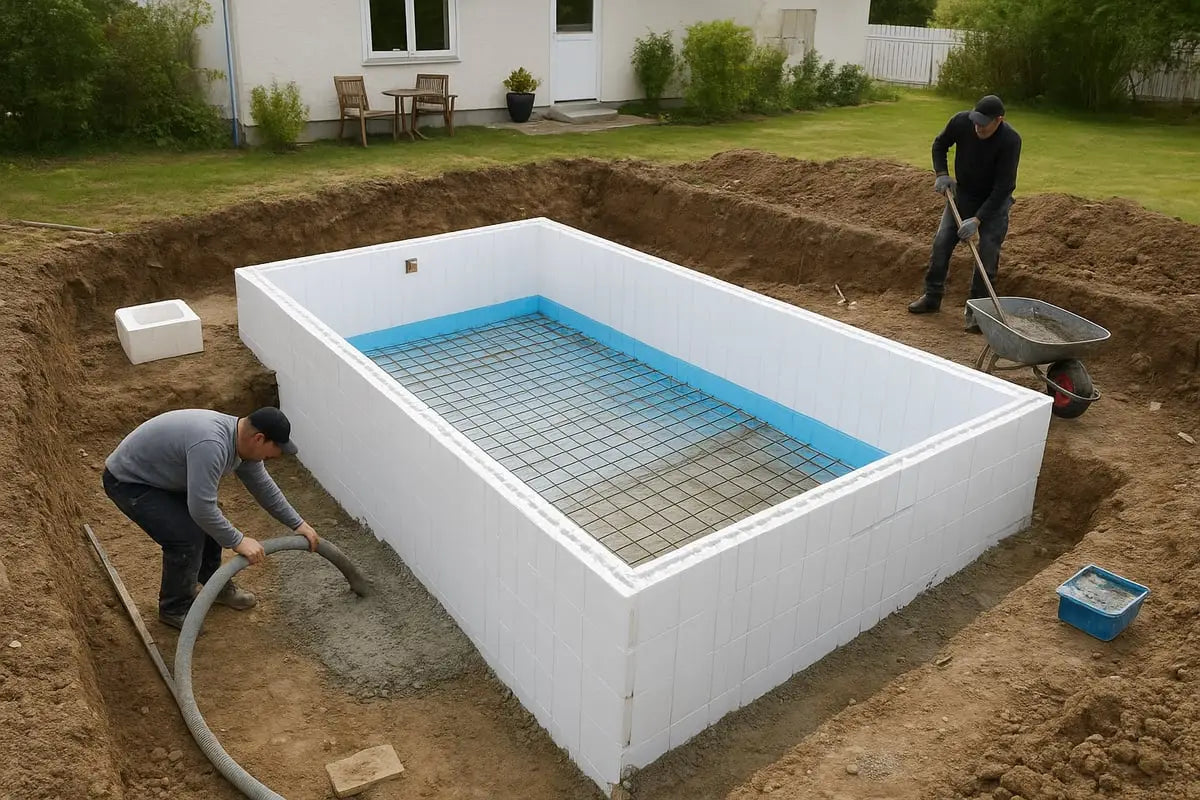
Before actual construction of your thermopool begins, it is crucial to assess ground conditions. Carefully check bearing capacity and drainage to avoid future problems. Measure and mark the pool area precisely.
Excavate for the pool and remove excess soil. Always use draining material, such as gravel, as a base to ensure stability and reduce the risk of settlement. If the groundwater level is high, extra measures such as drain pipes and a pump are required.
Groundworks often account for about 20 percent of the total cost of a thermopool. By spending time on careful preparation, you avoid costly mistakes later and ensure a long service life.
Assembly of thermo blocks and reinforcement
When the ground is ready, begin assembling the thermopool’s block system. The blocks are easy to handle and are based on a Lego principle where they are simply stacked on top of each other.
Start with the first course and carefully check measurements and height. Reinforcement is placed in the blocks according to the manufacturer’s instructions, which is crucial for the pool’s strength and service life.
Make sure the blocks fit tightly and are perfectly straight. Common mistakes include sloppy reinforcement or misaligned blocks, which can affect the entire thermopool’s stability. With careful execution, you get a secure foundation for the following steps.
Casting the base slab and walls
The next step is to prepare for concrete casting in your thermopool. Lay plastic and reinforcement mesh for the base slab. Casting should be done in dry weather and with the correct concrete quality.
The base slab should be even and thick enough to handle the load. When the slab has cured, the walls in the blocks are filled with concrete. Be sure to fill evenly and avoid air pockets.
Curing time varies, but allow at least one week before the next step. In cold weather, extra protection is required to avoid frost damage in the concrete. Casting usually takes 1–2 days and is crucial for your thermopool’s durability.
Installation of technology and connections
Now it is time to install the technology for your thermopool. Install the skimmer, inlets, and any lighting fixtures according to plan. Prepare for piping to the filtration unit, heat pump, and other functions.
Place the equipment room close to the pool to minimize heat loss and facilitate service. Install high-quality filtration and heating systems to avoid future problems.
Test all connections for tightness before proceeding. A well-executed installation saves both time and money in the long run and contributes to trouble-free operation of your thermopool.
Installing the liner and details
When the equipment is in place, it is time to install the liner in your thermopool. Measure carefully and make sure the liner is tailored to the pool’s exact dimensions. Install the liner carefully and work out any creases or bubbles.
Install steps, a ladder, or other details to create a safe and comfortable swimming environment. Fill the pool with water gradually and check that the liner sits correctly.
After about 15 years, it may be time to replace the liner, which is a simple process in a thermopool. Choose a high-quality liner for the best durability and minimal maintenance.
Backfilling, restoration, and finishing
When the pool is filled and watertight, it is time to backfill around the thermopool with draining material. This protects the structure and prevents settlement.
Restore the garden, patio, or paving to create a harmonious whole. Install a safety cover, a cover, or a pool enclosure for increased safety and energy efficiency.
Finish with a final inspection and functional check. The final finish often accounts for about 10 percent of the total cost and is crucial for your thermopool to enhance the entire property.
Common pitfalls and how to avoid them
Many problems when building a thermopool are due to carelessness or lack of knowledge. Incorrect drainage can cause settlement and damage to the pool. Insufficient reinforcement affects long-term durability.
Measurement errors during staking out or assembly cause problems when installing the liner and accessories. Too little ground insulation leads to higher energy consumption.
Learn from others’ mistakes and always follow the manufacturer’s instructions carefully. A well-built thermopool gives you many worry-free years and maximum swimming enjoyment.
Maintenance, Care, and Long-Term Economy
Owning a thermopool means not only wonderful swims, but also responsibility for maintenance and long-term economy. By taking care of your thermopool regularly, you extend its service life and keep operating costs down. Here you get concrete tips and facts on how to care for your pool year-round, what costs to expect, and how to ensure a hassle-free pool life.
Daily and weekly maintenance
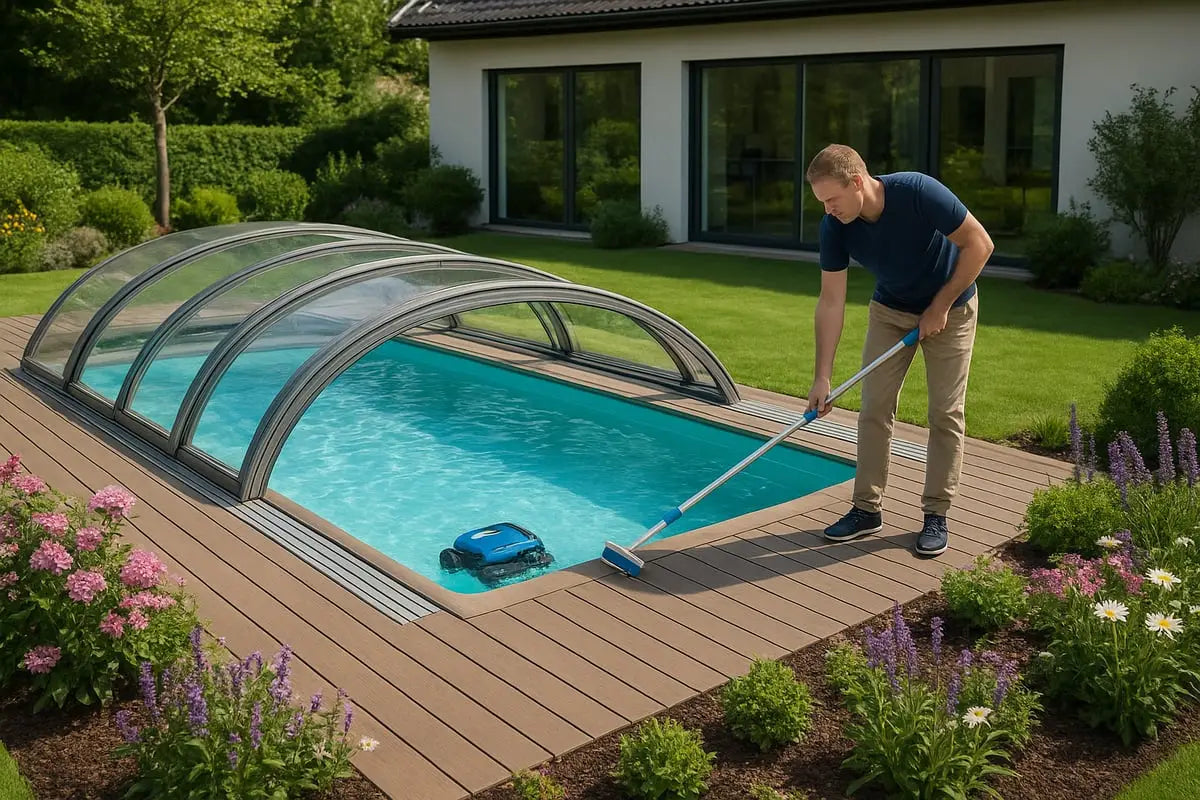
Regular maintenance is the foundation for keeping your thermopool fresh and inviting. Daily, check water level and circulation. Weekly, clean the pool surfaces, empty the skimmer basket, and backwash the filter.
- Check and adjust pH and chlorine
- Clean the pool floor, preferably with a pool robot
- Monitor the water level and top up if needed
Automatic dosing systems make it easy to keep the water balanced. Statistics show that 80 percent of Swedish pool owners use a pool robot for efficient cleaning. By prioritizing maintenance, your thermopool will have a longer service life and reduced maintenance needs.
Water quality and filtration systems
Clean water is the key to enjoyment and health in your thermopool. The choice of filtration system is crucial. The most common options are sand filters, UV sanitation, and salt chlorinators. Sand filters are standard and require regular backwashing. UV systems reduce chlorine consumption by up to 50 percent, providing softer water.
Test kits or digital meters make it easy to check water values. Blue Connect PRO is an example of smart monitoring via an app. Replace or clean filters according to the manufacturer’s recommendations. A well-maintained thermopool always provides crystal-clear water.
Winter closing and spring opening
The Swedish climate requires that you close your thermopool before winter. Start by lowering the water level below the inlets, clean the pool thoroughly, and add antifreeze to the pipes. Protect equipment and pumps from the cold and cover the pool with a winter cover or a pool enclosure.
- Empty and clean the filter and pump
- Make sure all valves are open
- Put on the pool cover for increased safety
Proper winterization reduces the risk of frost damage and breakage by 80 percent. When spring arrives, opening is simple: remove the cover, top up water, start the filtration system, and check water values. Your thermopool is ready for a new swimming season.
Operating and maintenance costs
The operating cost for a thermopool is affected by heating, chemicals, service, and accessories. With a pool enclosure and good insulation, electricity consumption can be halved compared with simpler pool types. The annual operating cost for a 4x8 meter thermopool is between 7 000 and 12 000 kronor.
| Cost item | Example per year (kr) |
|---|---|
| Electricity (heating) | 3 500 – 7 000 |
| Chemicals | 1 500 – 2 500 |
| Service/filter | 1 000 – 2 000 |
| Accessories/replacement | 1 000 – 2 500 |
Read more about costs and comparisons in Thermopool advantages and disadvantages. In the long run, a thermopool is one of the most economical pool types thanks to energy savings and durability.
Upgrades and add-ons over time
It is easy to upgrade your thermopool with new features. Many choose to install a heat pump or solar collectors afterward to reduce energy costs. Switch to energy-efficient pumps or upgrade the filtration system as needed.
Popular add-ons include LED lighting, jet stream, waterfall, and smart app-based control. Ideally, plan for future needs already at the build start so installation is smooth. With the right choices, you will enjoy your thermopool for many years to come.
Pool accessories and design possibilities
Choosing the right accessories is crucial for making your thermopool both functional and pleasant. With today’s wide range, you can tailor the pool to your needs, style, and garden environment. Below we go through popular accessories, design possibilities, safety aspects, and the latest technology trends for thermopools ahead of 2026.
Popular accessories for thermopools
A thermopool comes with a range of accessories that make the swimming experience both comfortable and safe. Pool covers, manual or automatic, protect against dirt and reduce heat loss. Pool enclosures in different heights and shapes extend the season and provide extra safety. Stairs, ladders, and ramps make the pool accessible to everyone.
Lighting such as LED or fiber optics sets the mood in the evenings. Jet streams and counter-current systems enable training and play. Statistics show that 60% of new thermopools are equipped with a pool enclosure. For comparisons between different pool types’ compatibility with accessories, please see Comparison between pool types.
A thermopool with an integrated waterfall and lighting gives an exclusive impression and increases the property’s value.
Design and customization to your garden
A thermopool can be customized in both shape and color to blend into the garden. Whether you want straight lines, rounded corners, or a freeform pool, there are solutions to suit your style. The choice of liner color and coping stones influences the overall impression and the ambiance around the pool.
Decking, paving, and plantings create a harmonious transition between pool and garden. For families with children, a shallow area or extra-wide steps can be smart, while adult swimming often prioritizes a lounge area and lighting. Modern functionalist gardens often choose recessed thermopools with minimalist design.
Tip: Customize the pool environment so that both house and outdoor areas form a cohesive whole.
Safety and legal requirements for accessories
Safety around your thermopool is always important. Swedish law requires an approved pool cover to prevent accidents, especially if there are children nearby. Manual or automatic covers that can support an adult’s weight are recommended.
A pool alarm or fence adds additional protection. For example, there are automatic pool covers that roll out and lock into place, making it easy to secure the pool when needed. Statistics show that accidents in private pools have decreased in step with better protection and clearer regulations.
Prioritizing safety when choosing accessories provides peace of mind for the entire family.
Smart solutions and technology trends 2026
Technology around thermopools is developing rapidly. App control of lighting, heating, and filtration gives full control directly on your phone. Automatic dosing systems keep water quality at its best with minimal effort.
Energy-efficient pumps and solar-powered accessories reduce operating costs and environmental impact. Smart monitoring provides notifications when values deviate, increasing safety. One example is controlling the entire thermopool via smartphone, wherever you are.
The insight is clear: With the right technology, pool ownership becomes simpler, more enjoyable, and more energy efficient.
Frequently Asked Questions about Thermopools
Planning and building a thermopool often raises many questions. Here you will find answers to the most common queries from both new and experienced pool owners. The guide helps you make confident decisions for your pool project.
How long does it take to build a thermopool?
The construction time for a thermopool varies depending on ground conditions and weather. With professional help, the process usually takes 4–8 weeks from groundbreaking to a finished pool. If you do parts yourself, it can take longer, especially if you have not built a pool before. A large portion of the time goes to groundworks and casting. For a detailed process, see Build a pool – step by step.
Can I build it myself, or is a professional required?
It is possible to build a thermopool yourself if you are handy and meticulous, but many choose to hire a professional for certain stages. Groundworks, reinforcement, and casting require special expertise. Incorrect installation can affect the pool’s service life and warranties. Many suppliers also offer split contracts, where you choose which parts you want to do yourself.
How much insulation is needed for the Swedish climate?
Thermopools are specially developed for Nordic conditions and have insulating blocks that minimize heat loss. For the best results, at least 10 cm of insulation in the walls and base is recommended. This allows the thermopool to retain heat significantly better than many other pool types.
What is the service life of a thermopool?
With proper installation and regular maintenance, a thermopool has a very long service life, often 30 years or more. The pool structure is robust, and the block system retains its shape over time. The liner is usually replaced after 10–20 years depending on quality and maintenance.
What does service and maintenance cost?
Annual operating cost for a thermopool is normally 7 000–12 000 kr. That includes electricity for heating, chemicals, filters, and service. If you use a pool enclosure and an energy-efficient heat pump, the cost can be lower. Service intervals for equipment and liner vary, but easy maintenance is one of the thermopool’s major advantages.
Can you replace the liner yourself?
Yes, it is entirely possible to replace the liner yourself in a thermopool, especially if you have some pool maintenance experience. However, many choose to get help for the best result and to avoid creases or damage. A liner replacement usually takes 1–2 days.
How much electricity does a thermopool use?
Electricity consumption is affected by the pool’s size, insulation, and type of heating. A well-insulated thermopool with a pool enclosure and a heat pump often uses 3 000–5 000 kWh per season. That is significantly lower than for traditional steel or concrete pools. Feel free to compare different heating options at Choose the right type of pool.
Can you use salt water in a thermopool?
Yes, a thermopool works excellently with a salt chlorinator. The materials in the blocks and liner can handle salt water, provided you use approved components. It is important to follow the manufacturer’s recommendations to avoid corrosion on metal parts.
What warranties are typically included?
Most suppliers provide long warranties on the thermopool’s structure, often 10–15 years on blocks and frame. The liner usually has a 5–10 year warranty. Warranties on equipment and accessories vary. Always check the terms and what is required for the warranty to apply.
Common questions from pool owners
The most common questions concern the construction process, operating costs, and choice of accessories. Statistics show that 70% of all questions to pool suppliers concern these areas. Do not hesitate to contact your supplier if you are unsure about anything—the right information gives you the greatest enjoyment from your thermopool.
How to choose the right supplier for your Thermopool
Choosing the right supplier for your thermopool is crucial for both the pool’s quality and your long-term peace of mind. A reputable company gives you better conditions for a successful project and smooth operation.
Criteria for choosing a supplier
When you invest in a thermopool, the supplier’s experience and expertise are decisive. Always choose a company with documented references from similar projects, so you can feel confident throughout the process.
Investigate material quality and what warranties are offered. A good supplier works with proven systems and provides clear warranties on both the thermopool and the installation. Also check whether the company offers its own customer service and technical support. Suppliers that handle both sales and after-sales often achieve higher customer satisfaction.
Also consider whether you want a turnkey contract or only help with certain parts of the build. Larger suppliers often have the resources for complete solutions, while smaller companies may offer a more personal touch. Statistics show that suppliers with in-house support have more satisfied customers, which reduces the risk of misunderstandings and problems along the way.
Pooltime® – Premium supplier of pools and thermopools
Pooltime® is one of Sweden’s most experienced suppliers of thermopools and premium pools. With over 20 years of experience and a broad range, they offer solutions well adapted to the Nordic climate.
The company specializes in energy-smart and long-term sustainable thermopool solutions. They offer turnkey delivery, which means they take responsibility for everything from planning to the finished pool. Pooltime® is also known for its first-class customer service and guidance throughout the project.
You will find exclusive thermopool products, innovative accessories, and smart technology for both new builds and upgrades. For more information, contact Pooltime® via www.pooltime.se, call 010-206 70 60 or email info@pooltime.se. With the right supplier, you get security and quality for your thermopool.
