

-
Full tub with the latest technology without carcinogenic PVC lining
ThermoPP pools are made of PP instead of liner. PP is a material that withstands higher temperatures, while also meaning you do not have to worry about the children’s toys damaging the liner.
The type of polypropylene used in our pools comes from the German company Röchling and is specially developed for pool manufacturing with UV-stable PP. The fact that the plastic is UV-stable means that the only thing that happens to the material over time is that it develops a more matte surface instead.
The material is available in several colours, and it makes it possible to manufacture special seating benches, various types of stairs, overflow systems, and only the imagination sets the limits.
-


Zero Weld Technology – a stronger, more elegant, and safer PP pool
-
See our range of ThermoPP pools
When you invest in a pool, you want something that will last for many years, look great, and feel safe every time you use it. With Zero Weld Technology you get exactly that – a modern construction that eliminates one of the biggest weaknesses of traditional pools: visible and vulnerable welded joints.
In standard PP pools, the transition between the floor and walls, as well as between the walls, is often welded. It is precisely in these joints that problems can easily arise over time – cracks, wear, or in the worst case, leaks. With Zero Weld Technology, these weak points are eliminated entirely. The result is a pool that is both stronger and more durable.
A stronger construction from the ground up
By removing the welded joints in the most exposed areas, the pool gains a more uniform and stable construction. Instead of stress being concentrated in the joints, it is distributed evenly across the entire pool structure. This allows the pool to better withstand stresses such as ground pressure, water volume, and temperature changes.
This also means that the risk of cracking is greatly reduced. Instead of something suddenly breaking, the material is designed to handle stress in a more controlled way. This provides a safer solution for you as a pool owner.

Zero Weld Technology – a stronger and more durable pool construction
-
Exclusive ThermoPP Pool in sustainable polypropylene material
Handles tough conditions
A pool is exposed to a lot – not just water, but also cold, heat, and movement in the ground. Pools with Zero Weld Technology are developed to handle exactly this.
They have been tested in extreme temperatures, where the water was even allowed to freeze completely, without the pool being damaged. This means you can feel safe even during cold winters.
In addition, the structure has been tested for impacts and transport, showing that it withstands heavy strain without losing its function or shape. This is clear proof that the quality lasts – not just in theory, but in reality.
Cleaner finish – no visible seams
Besides the strength, there is another major advantage: the design.
Without welded joints, you get a completely smooth and stylish interior. No visible lines, no unevenness – just clean surfaces that create an exclusive impression. This makes the pool look more premium and feel more thoughtfully made.
Cleaning also becomes easier, since dirt and algae do not stick as easily when there are no joints and edges.
-

-
Exclusive ThermoPP Pool in sustainable polypropylene material
Long-Term Peace of Mind
Choosing a pool with Zero Weld Technology is not just about how it looks today – it is about how it performs in 5, 10, or 15 years.
By eliminating the most vulnerable points, the risk of future problems is reduced. This means less maintenance, fewer concerns, and an investment that stands the test of time.
Why You Should Choose Zero Weld Technology
- No weak welded joints in critical areas
- Stronger and more durable construction
- Withstands cold, frost, and harsh conditions
- Elegant, smooth, and exclusive design
- Lower risk of cracks and leaks
- Long service life and a secure investment

-

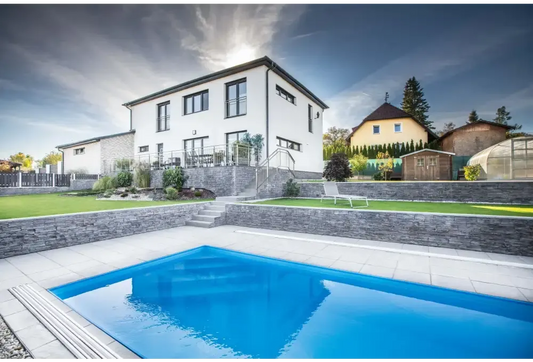
 Special price 30% off
ThermoPP pool package QBIG 3 × 5
10514 £10514 £015021 £ -
 Special price 30% off
ThermoPP pool package QBIG 3 × 6
11036 £11036 £015767 £ -

 Special price 29% off
ThermoPP pool package QBIG 3 × 7
12976 £12976 £018535 £ -
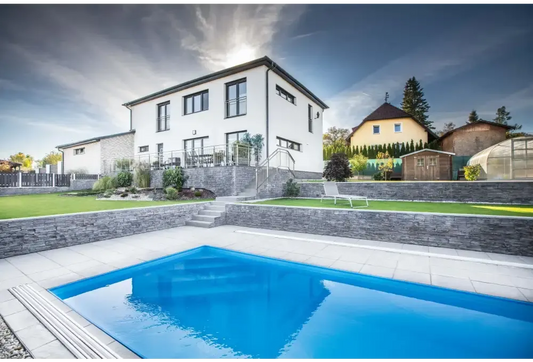
 Special price 30% off
ThermoPP pool package QBIG 3.5 × 7
13573 £13573 £019393 £
In our online store, you can configure your pool packages!
The staircase is built into the pool
-
Se our range of ThermoPP pools
The staircase is an important part of the pool’s construction. Until 2011, the staircases were sub-supported, meaning that cement was filled underneath the staircase. This outdated construction has been problematic both during installation and in the event of ground settlement and movement. Over the years, most manufacturers have instead chosen to replace it with a water-filled staircase. The pool itself is manufactured as a single water barrier, and the staircase is then built into the pool. This means there is no risk of the pool leaking if settlement were to occur in the staircase section. Under the staircase, there is water circulation directly from the sand filter, which is purified, and since algae do not form in darkness, there is no need to worry about the water quality beneath the staircase. At the bottom of the staircase, there are inlets through which the water then circulates out into the pool.
Our staircases are made from semi-protected “cubic grain” material with no edges and are a true masterpiece! Choose between a straight or rounded corner staircase with bench seating, a floating staircase, or a full-width end staircase. The staircase construction is very stable and does not flex thanks to skilled engineering calculations.
-

-

-
Made from 8 mm thick UV-stable PP thermoplastic from Roechling


1. Excavate, install drainage and cast a concrete slab.
The slab can either have a 10 x 10 cm groove along the line of the pool wall, or reinforcing bars can be drilled into the slab as shown in the options below:
-
Cast slab with grooves

-
Cast slab with vertical reinforcement


2. Lay insulation on the slab
-
Lay out the insulation upon the pool's arrival

-
If necessary, tape the insulation in place


