


Fiberglass or PP poolWhich pool should you choose?
glasfiberpool

25+ years

mixed materials in multiple layers, harmful materials in production.

installation 1-2 weeks

risk of bubonic plague & cracks

lower insulation capacity than a PP pool
PP pool
45+ years

homogeneous polypropylene sheets harmless and more environmentally friendly material
installation 1-2 weeks

no risk of bubonic plague & cracks
Energy-efficient thanks to its high insulating capacity

Manufacturing and materials
Glasfiberpools are manufactured in carefully controlled factories, as fiberglass is a hazardous material and safety must be handled with great care during production. Pool manufacturers wear protective masks and protective gloves, among other things, to protect themselves from getting fiberglass particles into their bodies.
During manufacturing, a mold is used in which the gelcoat that gives the pool its color is sprayed on. After this, some form of water barrier in the form of vinyl ester or epoxy is applied, followed by a "core" that gives the pool its strength. The core may be made of composite, ceramic, Kevlar, or basalt fiber mesh, and its purpose is to hold the pool together and protect it against cracks, as well as give it its elasticity. Outside this core, a layer of polyester is then applied.
Once this is finished, the glasfiberpool is lifted from the mold, and because of the shape of the mold, the corners of the pool become rounded. Glasfiberpools are often perceived as a large bathtub because of this.
A glasfiberpool has a varying number of layers, usually ranging from four to nine layers. Depending on how many layers the pool has, the pool walls are somewhere between five to eight millimeters thick, and the various layers most often consist of polyester and vinyl ester.
Fiberglass or PP pool?
Glasfiberpools have long been a popular option in Sweden for those buying a pool. They are popular among families with children because of their soft lines and sparkling material. Another reason for the popularity of glasfiberpools is that it takes no more than about a week to have the pool installed and ready to use.
There are many different manufacturers of this type of pool, ranging from American and Australian manufacturers to Polish and more local manufacturers. This means that the quality (and lifespan of the pool) can vary between different manufacturers.
The lifespan of a glasfiberpool is affected partly by the materials used and partly by how the pool is manufactured. A cheap glasfiberpool may have a lifespan of around 4-5 years before problems begin to arise, while a more expensive glasfiberpool can last for up to 25 years before problems occur.
The most common problems that most glasfiberpools suffer from over time are blistering (also called osmosis) and cracks that occur when water penetrates the different layers of the pool.
A PP Pool, on the other hand, has a lifespan of at least 45 years and suffers from neither blistering nor cracking.

Lifespan of glasfiberpool
So, what is the lifespan of a glasfiberpool?
The lifespan is determined partly by how many layers the pool has and what material it is made of. Vinyl ester has significantly greater durability than polyester, but it is also five times more expensive, which is reflected in the price of the pool.
If you buy a cheaper glasfiberpool, it is probably made of polyester, and there are pools made of polyester that cost as little as about 20 000 kr, but their lifespan is only four to five years. This type of budget pool is often manufactured in Poland or Estonia.
Glasfiberpools with a longer lifespan (25 years and up) are often made of vinyl ester and usually cost from around 100 000 kr, and are often manufactured in Australia or the USA. Glasfiberpools made of vinyl ester are also sometimes called composite pools.
There are now pools on the market that contain both polyester and vinyl ester, where the materials have been mixed to increase lifespan. How long such a pool lasts depends on the number of layers, how many of the layers are made of polyester/vinyl ester, and how careful they were during the manufacture of the pool.
Delivery & installation
glasfiberpools are delivered just like PP Pools as a “complete shell” – meaning that the pool is delivered in one piece, with the pool’s bottom, walls, and steps fully complete. Nowadays, a “complete shell” is preferred because the installation time for the pool is then much shorter, which results in a lower installation cost.
The installation of a glasfiberpool is დაახლოებით the same as for a PP Pool. The installation of a glasfiberpool is carried out as follows:
- First, a hole is dug where the pool is to be installed
- Then the base layer, drainage pipe, and drainage well are put in place
- After that, a base slab is cast
- Once the pool has been lowered into place, it is filled with water while the sides are backfilled with dry concrete mix and concrete
The above procedure takes no more than 1–2 weeks from delivery until the glasfiberpool / PP Pool is ready for use.
-
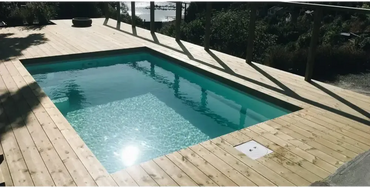
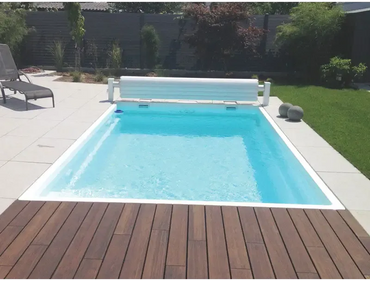 Save 15%
Fiberglass Pool Victoria 4.70m x 2.70m x 1.30m
10063 £10063 £011959 £ -
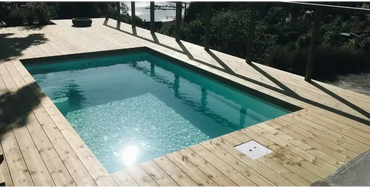
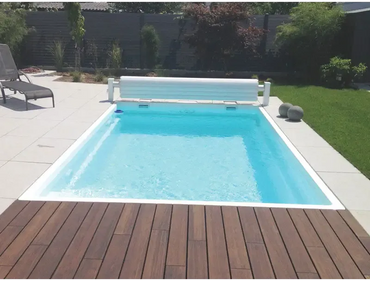 Save 16%
Fiberglass Pool Saba 500 5.00m x 3.00m x 1.45m
11715 £11715 £014005 £ -
 Save 16%
Fiberglass Pool Jamaica 11.25m x 3.75m x 1.50m
25956 £25956 £031077 £
Blistering (osmosis) in fiberglass pools
A glasfiberpool consists of different layers of polyester or vinyl ester. These materials are not waterproof, and polyester, for example, allows water to pass through after just one year. When water molecules have penetrated one layer and are located between two layers, mold growth occurs. The mold in turn creates a gas that pushes out the sides of the glasfiberpool, and this is the reason why glasfiberpools are affected by blistering (osmosis).
The most common reason a glasfiberpool is affected by blistering is that the material is of poor quality or that quality control during the pool's manufacturing was inadequate. If your pool has been affected by blistering/osmosis in one place, there is unfortunately a high risk that your pool will soon be affected in more places.
Another problem with water molecules penetrating the different layers in a glasfiberpool is that when winter and the cold arrive, the water molecules freeze into ice and cause cracks in the pool.
These problems are avoided if you instead buy a PP Pool, which consists of a homogeneous material and therefore is affected by neither blistering nor cracks in the material.
Repair of a glasfiberpool that has developed blistering or cracks
It is often possible to repair a glasfiberpool that has been affected by osmotic blistering. The repair is carried out by sanding away part of the material and then filling the hole with gelcoat.
Unfortunately, this type of repair is quite costly and is done as a targeted intervention on the affected area of the pool. Since in the vast majority of cases a glasfiberpool that has once been affected by osmotic blistering will usually develop it in more places, the repairs eventually become expensive.
To avoid costly repairs to your pool, you should therefore choose a PP Pool, which does not risk being affected by osmotic blistering or cracks due to water molecules penetrating the different layers. Another advantage of a PP Pool is that if any other kind of damage should occur to the pool, the damage can easily be welded shut with an extrusion tool.
PP Pool – Manufacturing and materials
A PP pool is made from the material polypropylene. Unlike fibreglass, polypropylene is not harmful to humans, but is an environmentally friendly material that is also approved for various types of food containers and drinking water containers.
During manufacturing, homogeneous sheets are welded together using a welding machine, and the staircase is also welded in place using extrusion tools. The sheets that make up the pool are between 8 mm and 12 mm thick, creating a stable and durable construction.
The material in a PP pool comes in different colours, giving you the opportunity to choose the colour that suits you best.
